The Firefighting Tipping Point: Why Working Harder Won’t Get Your Project Back on Track

Some projects reach a point where the harder everyone works, the further behind they fall.
More meetings. Longer hours. More people pulled into urgent problems.
Yet the next crisis is already forming.
Most project managers know the feeling. You start the week with a plan. By Tuesday, a supplier has missed a delivery, a test has failed and a stakeholder wants a change “by Friday”. You work through each one. The following week, a new set of problems arrives.
The natural response is to work harder. But what if all that extra effort is quietly creating the conditions for the next crisis?
Research into firefighting in project management suggests that organisations can reach a tipping point where fixing today's problems takes so much time and attention that the work needed to prevent tomorrow’s gets pushed aside. Beyond that point, effort alone is no longer enough to restore control.
What the research tells us
In 2001, Nelson Repenning of the MIT Sloan School of Management published research examining firefighting in product development organisations. He described firefighting as the unplanned allocation of resources to resolve problems discovered late in a project’s life cycle.
His research revealed a troubling pattern: firefighting can become self-reinforcing. The more organisations divert to urgent problems, the less remains to prevent future ones.
The challenge becomes particularly serious when several projects depend on the same people or equipment.
In a related study, Repenning, Paulo Gonçalves and Laura Black explored what happens when this cycle reaches a tipping point. They compared the spread of firefighting across projects to the spread of an infectious disease.
Below a certain threshold, problems remain relatively contained. Above it, firefighting can spread throughout the organisation, making recovery increasingly difficult.
Although the research focused on product development environments, the underlying pattern is relevant to many organisations managing multiple projects with shared resources.
How firefighting becomes a cycle
- A problem emerges late in a project. A missed deadline, unexpected defect or unresolved requirement demands immediate attention.
- Resources are redirected to deal with the crisis. People are pulled away from planning, design reviews, risk assessments or work on other projects.
- Important early-stage activities are delayed or rushed. With fewer resources available, teams take shortcuts to keep work moving.
- New problems emerge later. Inadequate planning, overlooked risks and unresolved issues create difficulties that only surface close to delivery.
- The organisation faces another crisis. More people are redirected to urgent work, and the cycle begins again.
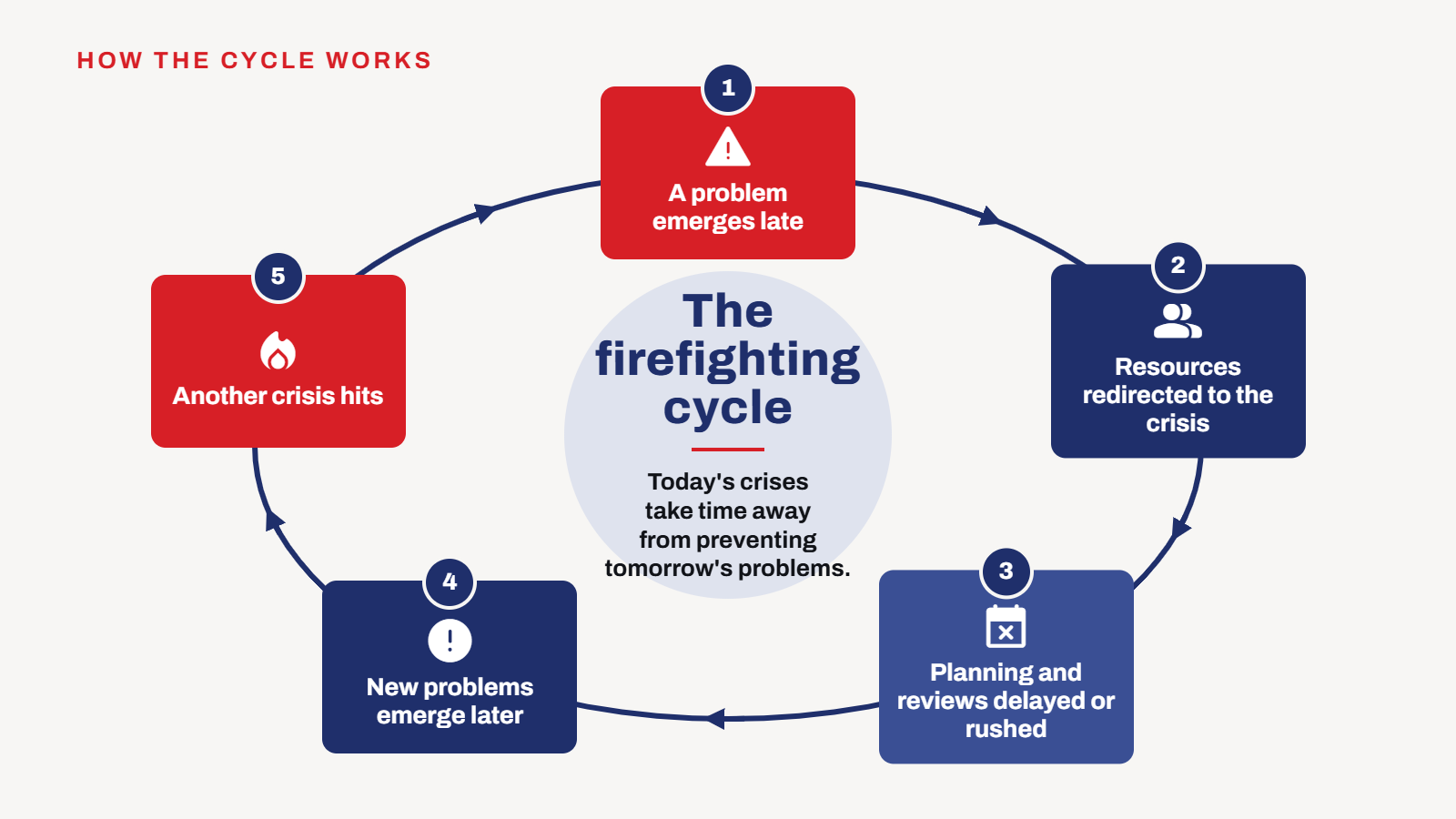
The team ends up working harder than ever, mostly on problems that could have been avoided.
Firefighting is visible. The person who works through the night to rescue a delayed project gets praised. The person whose careful planning prevented a crisis rarely gets noticed.
Over time, organisations end up rewarding firefighting and undervaluing prevention.
Why working harder eventually stops helping
An occasional crisis is part of project management. A team with sufficient capacity can respond to an unexpected problem, resolve it and return to its planned work.
The difficulty begins when urgent problems consume so much time that normal work can no longer recover.
At that point, every hour spent dealing with today’s problem becomes an hour unavailable for preventing tomorrow’s.
One important factor identified in the research is resource utilisation.
When people are allocated close to 100% of their available capacity, there is very little room to accommodate the unexpected.
A delayed delivery, technical problem or urgent change request can force other planned activities to be postponed. If those postponed activities are essential to preventing future problems, the organisation becomes increasingly vulnerable.
This challenges a common management assumption.
A fully occupied team is not necessarily an efficient team.
Spare capacity looks wasteful on a resource plan. In practice, it’s often what keeps delivery reliable.
Seven warning signs that firefighting is taking over
No single symptom proves that a project or organisation has crossed the tipping point. But several occurring together should prompt closer attention.
- Planning sessions and design reviews are repeatedly postponed because everyone is too busy.
- The same people are called into every urgent meeting, often across several projects.
- Problems are regularly discovered during testing, commissioning or handover instead of earlier in the project.
- Risk registers are outdated because nobody has time to review them.
- New projects begin before their scope and requirements have been properly defined.
- Last-minute rescues receive more recognition than projects delivered smoothly.
- Overtime has become an expectation rather than an occasional exception.
A useful question to ask is:
If your team spent the next two weeks dealing only with urgent problems, what important work would be left undone?
The answer shows which activities keep being sacrificed to keep today’s projects moving.
Those are often the very activities needed to prevent the next crisis.
Six ways to break the firefighting cycle
Once firefighting becomes self-reinforcing, simply asking people to work harder is unlikely to solve the underlying problem.
Breaking the cycle requires changing how work is planned, prioritised and resourced.
1. Protect the work that prevents problems
Planning, scope definition, risk reviews and design assessments should not automatically be the first activities sacrificed when something urgent happens.
Treat these activities as essential project commitments. Where possible, avoid repeatedly reassigning the people responsible for these activities to deal with emerging crises.
Clear scope, planning and a defined way of working are what keep a project out of crisis mode in the first place. We explored this in Why Projects Fail, Part 2.
2. Leave room for the unexpected
Avoid planning teams at full capacity.
Build realistic allowances into resource schedules and maintain appropriate contingencies for unexpected challenges.
The objective is not to leave people unproductive. It is to ensure that responding to one unexpected problem does not automatically disrupt several other activities.
3. Be willing to make difficult short-term decisions
Sometimes this means delaying a deliverable, reconsidering priorities or postponing the start of another project.
These decisions are uncomfortable, especially when sponsors are focused on immediate deadlines.
Continuing to overload the same people may ultimately create more delays than making one deliberate adjustment.
4. Identify problems earlier
Use design reviews, early testing, prototypes, stakeholder discussions and regular risk assessments to uncover potential problems before they become urgent.
Catching issues early reduces the cost and disruption of fixing them later.
The aim is not to eliminate uncertainty, but to address it while there is still time to respond effectively.
5. Limit work in progress
Starting more projects does not necessarily mean delivering more projects.
When too many initiatives compete for the same people, progress slows across the entire portfolio.
Consider whether fewer active projects, each with sufficient resources and clear priorities, would produce better results than spreading teams too thinly.
6. Recognise prevention, not only recovery
Organisations naturally celebrate the people who rescue troubled projects.
But effective planning, early risk identification and smooth delivery deserve recognition too.
Ask what contributed to a project running well. Share those lessons across teams.
Build a culture where preventing problems is valued as highly as solving them.
The real lesson: Prevention is part of performance
Firefighting is not always a sign of poor project management. Unexpected problems will occur, even in well-managed projects.
But when every week becomes a series of emergencies, it’s time to look at the system, not at how hard people are working.
Are too many projects competing for the same resources? Is there enough time for planning? Are teams being rewarded for preventing problems, or primarily for rescuing projects when things go wrong?
Often, the problem isn’t a lack of effort. It’s where that effort is being directed.
The real measure of effective project management isn’t how many fires a team can put out. It’s how many fires never start.
Planning, risk management and resource scheduling are at the heart of the University of Pretoria’s Programme in Project Management.
References
Repenning, N. P. (2001). Understanding fire fighting in new product development. Journal of Product Innovation Management, 18(5), 285–300.
Free version via MIT DSpace
Repenning, N. P., Gonçalves, P. & Black, L. J. (2001). Past the Tipping Point: The Persistence of Firefighting in Product Development. California Management Review, 43(4), 44–63. >https://doi.org/10.2307/41166100


